
Why guards come up so often in Hoover
Much of Hoover was built on wooded hillsides, and the trees left standing are now taller than the houses. Add a basement level that makes the back of the house two or three stories high, and you have gutters that fill quickly and are hard to reach. That is exactly the situation guard companies look for, so it pays to have your own way of deciding.
One thing to settle first: guards reduce cleaning; they don't end it. Every design still needs a look and usually a brush-off or rinse at least once a year. Anyone promising otherwise is selling, not advising.
Five questions that decide it
Answer these for your own house. If most answers land in the right column, guards deserve a serious look. If most land on the left, a cleaning schedule is probably the better value.
| Question | Points toward cleanings | Points toward guards |
|---|---|---|
| What hangs over the roof? | Open sky or a couple of small ornamentals | Tall pines, oaks, sweetgums or tulip poplars reaching over the eaves |
| How often do gutters clog? | Once a year, after the leaves | Spring, summer and fall |
| How high is the tallest side? | One story over flat ground | Two or three stories, or a basement side on a slope |
| What shape are the gutters in? | Loose, leaking or undersized: fix first | Straight, tight and draining well |
| How long will you stay? | Moving in a few years | Planning to stay a long time |
The first and third questions matter most. Heavy debris on a roofline that is hard or risky to reach is where guards earn their cost. Light debris on an easy roofline almost never justifies it.
Hoover's trees and how guards handle them

Most Hoover yards have a mix of pines and hardwoods. Common ones include loblolly pines, water and willow oaks, sweetgums, tulip poplars, hickories and red maples. Each one tests a guard differently.
Pines: the hardest case
Needles are long, thin and stiff. They slip through screens, stab into foam and follow water into the slot of hood-style guards. On a flat guard they mat down and shed rain over the edge. Pines also shed through most of the year, and every spring they coat everything in yellow pollen, which forms a film on fine mesh. Under pines, only a fine micro-mesh is worth considering.
Oaks: easy leaves, messy spring
Broad oak leaves are what guards handle best; they sit on top and blow off once dry. The catch is April, when stringy oak tassels drop by the bucketful and cling to mesh until a rain or a brush clears them. Water and willow oaks also tend to hold some leaves into winter, so the fall drop can run late.
Sweetgums: downspout jammers
The spiky seed balls roll to the outlet of an open gutter and wedge in the downspout elbow. Guards keep most of them out, which is a real benefit, but they can sit on top of mesh and trap leaves behind them.
Tulip poplars and hickories
Tulip poplars drop big leaves early, sometimes by late summer, plus flower parts in spring. Hickories drop nut husks that can crack cheap plastic screens. Both are easy for sturdy guards and hard on flimsy ones.
Rule of thumb: under hardwoods, most decent guards work and the question is price. Under pines, the question is whether the guard is fine enough, and cheaper designs usually aren't.
Which guard for which debris
| Guard family | Oak and poplar leaves | Pine needles and pollen | Sweetgum balls, tassels | Usual upkeep |
|---|---|---|---|---|
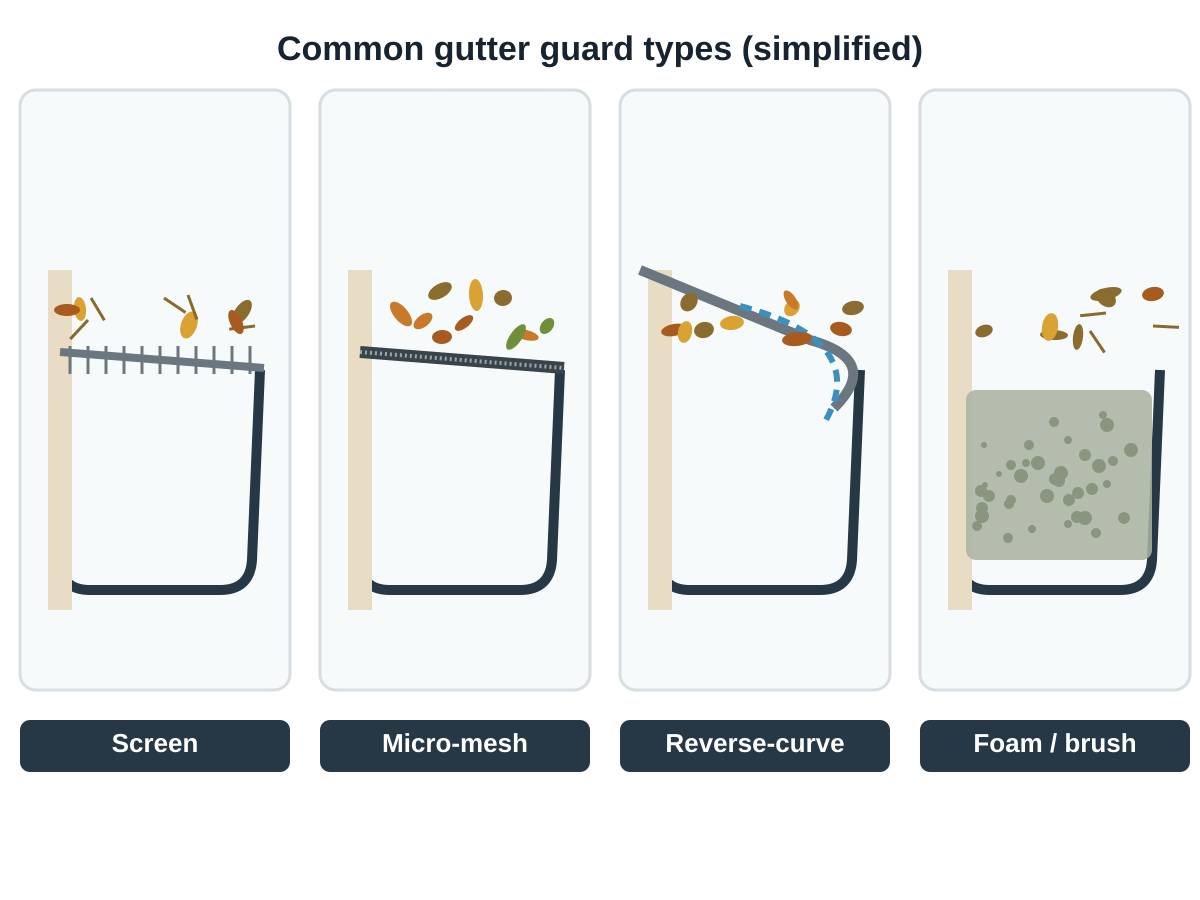
| Perforated screen | Good | Poor | Fair | Clear clogged holes; clean the gutter now and then |
| Fine micro-mesh | Very good | Good | Good; may sit on top | Brush or rinse the surface |
| Hood / reverse curve | Good | Fair | Fair | Grit collects in the hidden gutter |
| Foam or brush insert | Fair | Poor | Poor | Pull out and clean; replace as it breaks down |
Screens and inserts are cheap and can be fine on a one-story house under a few maples. Hoods change the look of the roofline and can overshoot in heavy rain. For most mixed pine and hardwood lots in Hoover, fine mesh on a rigid frame is the most versatile choice. See installed options on the gutter guards page.
The payback math
We don't publish prices, because guard quotes vary widely from house to house. You can still judge value with a simple worksheet:
- Write down how many professional cleanings you need each year to keep the gutters flowing.
- Multiply by what a cleaning costs you now. That is your yearly cleaning cost.
- Get a full installed quote for guards, including any repairs needed first.
- Subtract the cost of the occasional check or rinse the guards will still need.
- Divide the guard price by the yearly savings. That is roughly how many years it takes to break even.
If the break-even point is longer than you expect to live in the house, cleanings are the better deal. The things that move a guard quote most are total footage, the height of the tallest side, the guard material, prep work and the gutter style. The cost guide explains the cleaning side of the comparison.
Guards in a Birmingham downpour
Birmingham averages roughly 53 to 56 inches of rain a year, and a lot of it arrives in short, heavy bursts during spring storms and summer thunderstorms. On a steep roof, water moves fast. A guard that sheds leaves well can still let water sheet past the gutter at inside corners and valleys. Ask the installer how their guard handles a steep pitch in a cloudburst, and whether they add splash guards at valleys.
When to say no
A good professional will sometimes talk you out of guards. Skipping them is usually right when:
- Tree cover is light. If one cleaning a year keeps things flowing, guards will take a very long time to pay off.
- The gutters are failing. Sagging runs, leaking seams, loose spikes or soft fascia come first. Guards on a failing system only add weight and hide damage. See gutter repair and fascia repair.
- Gutters overflow even when clean. That points to gutters that are too small or too few downspouts. Guards cannot solve that; larger seamless gutters or added downspouts might.
- Pines overhead and only a cheap guard on offer. Under pines, a cheap screen or foam insert usually adds work rather than saving it.
- You are selling soon. Buyers rarely pay extra for guards; clean, tight gutters matter more at inspection.
Before anything is installed
If you go ahead, the preparation matters as much as the product. Ask the installer to:
- Clean the gutters and flush every downspout, including buried lines.
- Check the slope and re-hang any sections that hold water.
- Swap loose spikes for hidden hangers and repair soft fascia.
- Reseal leaking corners and seams.
- Show how the guard fastens and whether it goes under or through the shingles.
- Put in writing what upkeep the guards will still need.
It is also fair to ask for a cleaning-only price next to the guard quote. Comparing the two is the whole point, and a straightforward professional won't mind.
Signs you are being oversold
- The guard pitch comes before anyone has looked at your trees or your gutters.
- You hear that you will "never clean your gutters again."
- The price only holds if you sign today.
- Nobody mentions the sag, leak or soft fascia you can see from the driveway.
The bottom line
Guards are worth it in Hoover when heavy debris meets a roofline that is hard to reach, the gutters are in good shape, and the guard is fine enough for what falls on it, which under pines means micro-mesh. They are rarely worth it on lightly shaded, easy-to-reach houses or on gutters that need repair. Either way, pair them with a sensible routine; the Hoover gutter calendar shows when each tree does its damage.
Want a professional opinion on your home? Call (205) 973‑4758 or request a free estimate and say whether you want a cleaning quote, a guard quote or both. We'll connect you with an experienced, qualified local professional. Installed options are on the gutter guards page.