
Why downspouts matter so much here
Birmingham-area soils are heavy in clay. Clay takes in water slowly, so a downspout that empties at the base of the wall creates a puddle that runs sideways along the foundation instead of draining away. On a hillside lot, the uphill side of the house also collects the runoff from the yard above it. Add a basement or crawl space and the downspouts become the first line of defense against water getting inside.
Signs that roof water is not getting far enough away:
- Trenches or bare spots in the beds below a downspout
- Red clay splashed on siding, brick or the garage door
- Damp basement walls or standing water in the crawl space after storms
- Mildew or efflorescence (white, chalky deposits) on the foundation wall
- A walkway or patio slab that has tilted or cracked near a downspout
Clearing clogged downspouts
Most clogs form at the gutter outlet or in the first elbow below it. In Hoover, the usual culprits are sweetgum balls, oak tassels, pine straw and the grit that washes off aging shingles. A pro typically clears the outlet from above, then flushes the downspout with a hose and, if needed, a plumbing snake, and takes apart any elbow that stays packed. Every downspout should be water-tested before they leave.
If the same downspout clogs over and over, the fix may be a larger outlet or a 3x4 downspout in place of a 2x3, which gives debris more room to pass through. A gutter guard or a simple outlet strainer can help too; see are gutter guards worth it? before paying for a full system.
Buried drain lines
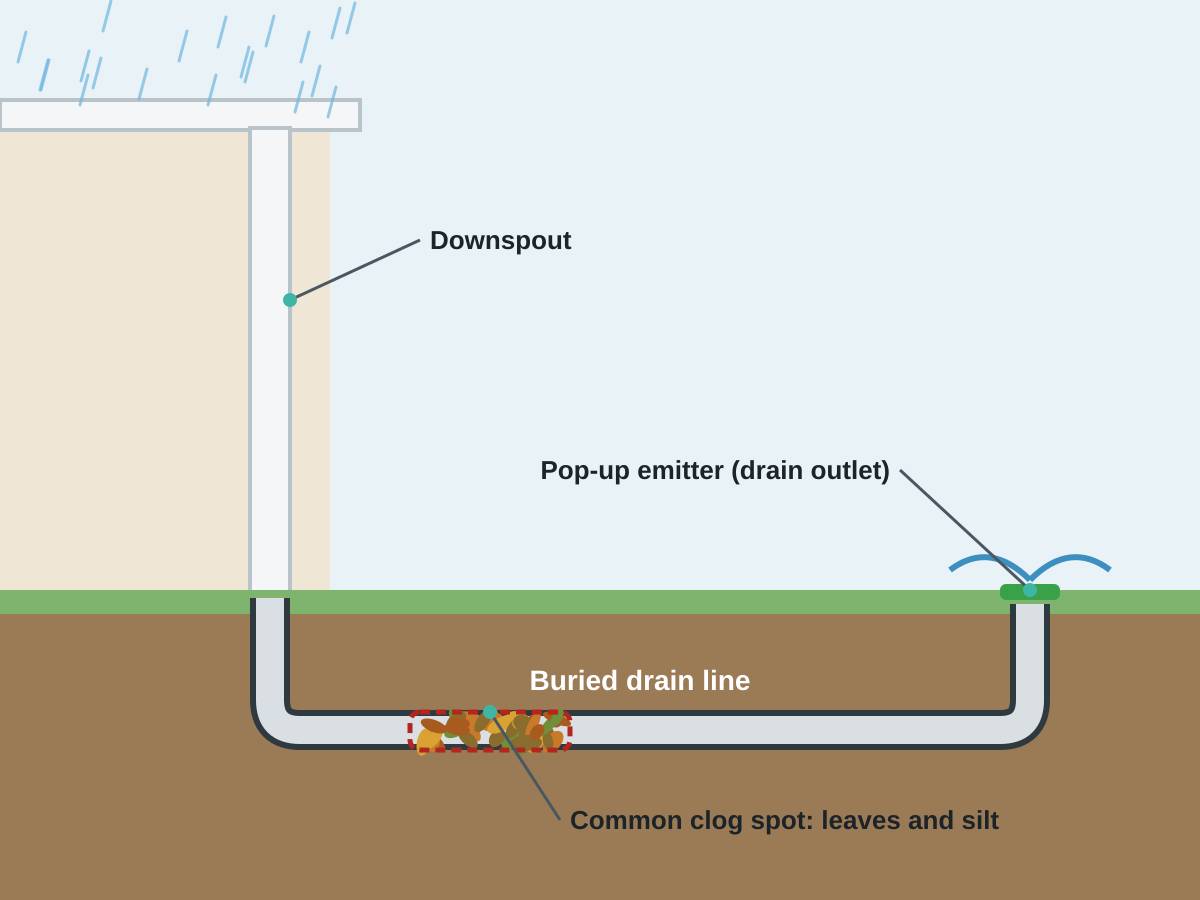
Many Hoover homes, especially newer ones in Ross Bridge, Trace Crossings, Lake Cyrus and Greystone, send downspouts into corrugated or PVC pipe buried in the yard. These work well until they don't:
- Debris washes down and settles in low spots or at the emitter, until water backs up and bubbles out of the downspout joint.
- Roots find their way in through joints and slits, especially near oaks and willows.
- Corrugated pipe crushes under mowers, cars or settling clay.
- The outlet gets buried by mulch, sod or a new bed, and the line has nowhere to go.
Clearing a line usually means flushing it with water, running a drain snake or jetter through it, and uncovering the emitter. When a section is crushed or full of roots, it may need to be dug up and replaced, ideally with smooth-walled pipe that is easier to clean later.
Rerouting water away from the house
Sometimes the problem is not a clog but where the water goes. Options a pro may suggest:
- Longer extensions that carry water past beds and down the slope
- Splash blocks turned so they actually point downhill
- A new buried line to a lower part of the yard, a dry creek bed or a pop-up emitter
- Moving a downspout to a corner where the ground falls away from the house
- Adding a downspout to a long run that dumps too much water at one point
Where the water ends up matters to your neighbors too. Keep it on your own lot, and ask the City of Hoover or your HOA before tying into a street or storm drain.
What affects the price
- How many downspouts need clearing, and how high they are
- Whether the clog is above ground or somewhere in a buried line
- The length of any buried pipe and whether it has to be dug up
- Rocks, roots and hard clay along a new pipe route
- Whether the work is added to a regular gutter cleaning
See the cost guide for more, or call (205) 973‑4758 for a free estimate.
Questions to ask
- Will you flush every downspout, including the ones that go underground?
- Can you find where my buried line comes out, and is it draining?
- Would a larger downspout help on the runs that keep clogging?
- Where would you send the water, and will it stay on my property?
Get connected
If water is backing up out of a downspout, pooling at the foundation, or showing up in the basement after storms, tell us what you see. We'll connect you with an experienced, qualified local pro who works in Hoover and the nearby suburbs.