
Why storms are hard on Hoover gutters
Spring is the peak of severe weather season in Alabama, and late fall brings a second, smaller one. Hoover has seen its share: in May 2004 a small tornado that began near the crest of Shades Mountain tracked through Bluff Park and damaged dozens of homes, and the April 27, 2011 outbreak tore across the Birmingham area. Most storms are far less dramatic, but even an ordinary line of thunderstorms can bring down limbs from the tall oaks and pines that shade so many Hoover homes, drop hail, and push a clogged gutter past its limit.
Safety first
- Stay off the roof and ladders until everything is dry and you know the gutters and limbs are stable.
- Stay away from downed or sagging power lines, including the service line to your house, and call Alabama Power.
- Keep people and cars out from under any gutter that is hanging, and any limb that is caught in a tree.
- Watch for hidden hazards in the yard: nails, broken glass and slick clay.
The ground-level checklist
- Walk the whole house from the ground. Look at every side, including the tall basement side you rarely see. Note anything hanging, bent, leaning or missing.
- Look for limbs and debris. Branches on the roof, in the gutters or leaning on downspouts. Do not try to pull them down from a ladder.
- Check the gutter line. A straight line along the eave is good. A dip, a bow or a gap between the gutter and the house means hangers let go.
- Check the downspouts. Are they still attached at the top and bottom? Are elbows and extensions in place, and is water coming out where it should?
- Look for hail dents. Round dents along the front of the gutters and on downspouts, easiest to see in low light.
- Look at the ground. Fresh washouts in beds, red clay splashed on the siding, or water standing by the foundation show where gutters overflowed.
- Check inside. Look at basement walls, crawl space, attic and ceilings near exterior walls for new water stains.
- Photograph everything. Wide shots of each side of the house, then close-ups of every damaged spot. Keep the date and time.
Common storm damage and what it means
| What you see | What it usually means | Usual next step |
|---|---|---|
| Round dents along the gutter face | Hail; often cosmetic if the gutter still drains | Photograph; include in any roof inspection |
| A section hanging or pulled off the fascia | Broken hangers, sometimes torn fascia | Keep clear; gutter repair |
| A crushed or kinked section | Limb impact | Splice or replace the section |
| Downspout detached or elbow missing | Wind or water force | Reattach; check where it drains |
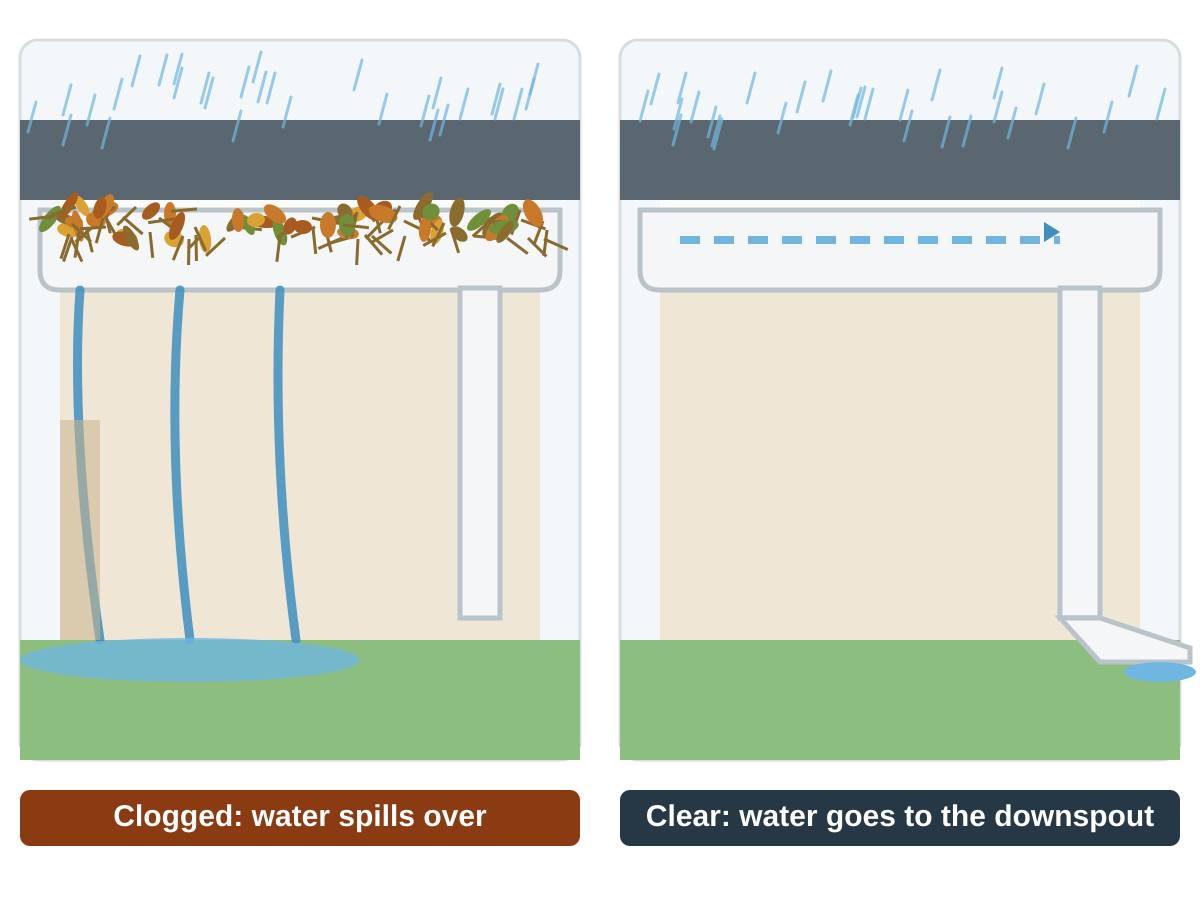
| Water poured over the gutter during the storm | A clog, or gutters too small for the roof | Cleaning first; consider larger gutters |
| New washouts or water by the foundation | Overflow or a downspout draining in the wrong place | Downspout and drain work |
| New stains on fascia or soffit | Water running behind the gutter | Fascia and soffit check |
Photos and insurance
If the storm damaged the roof, gutter damage is often part of the same claim. Before anything is repaired or cleaned up:
- Photograph each side of the house from the yard, then each damaged area up close.
- Photograph signs of the storm itself: hail on the ground, dented vents or cars, fallen limbs.
- Note the date and time of the storm.
- Keep damaged pieces if a pro removes them, until your insurer says otherwise.
- Read your policy or call your agent about deductibles before you commit to repairs.
Be wary of storm chasers. After big storms, out-of-town crews often go door to door. Be cautious about anyone who pressures you to sign right away, asks for large payments up front, or offers to "cover your deductible." Alabama's Home Builders Licensure Board licenses residential roofers and larger home improvement contractors, so ask for a license number on bigger jobs and check it.
What to fix first
- Anything that is a safety hazard: hanging sections and limbs on the roof.
- Anything letting water into the house: torn outlets, detached downspouts, gutters dumping water on the foundation.
- Clogs: storms knock a lot of leaves and twigs loose, so a cleaning after a big storm often makes sense.
- Cosmetic dents can wait for your insurance decision or the next scheduled visit.
A good time to think about the future, too: if the same gutters overflow in every storm even when clean, they may be too small for the roof. And if limbs keep landing on the gutters, trimming the trees may do more than any guard. If you are weighing guards anyway, read are gutter guards worth it? and compare designs on the gutter guards page.
Storm damage to your gutters? Call (205) 973‑4758 or request a free estimate. We'll connect you with an experienced, qualified local professional who serves Hoover.