
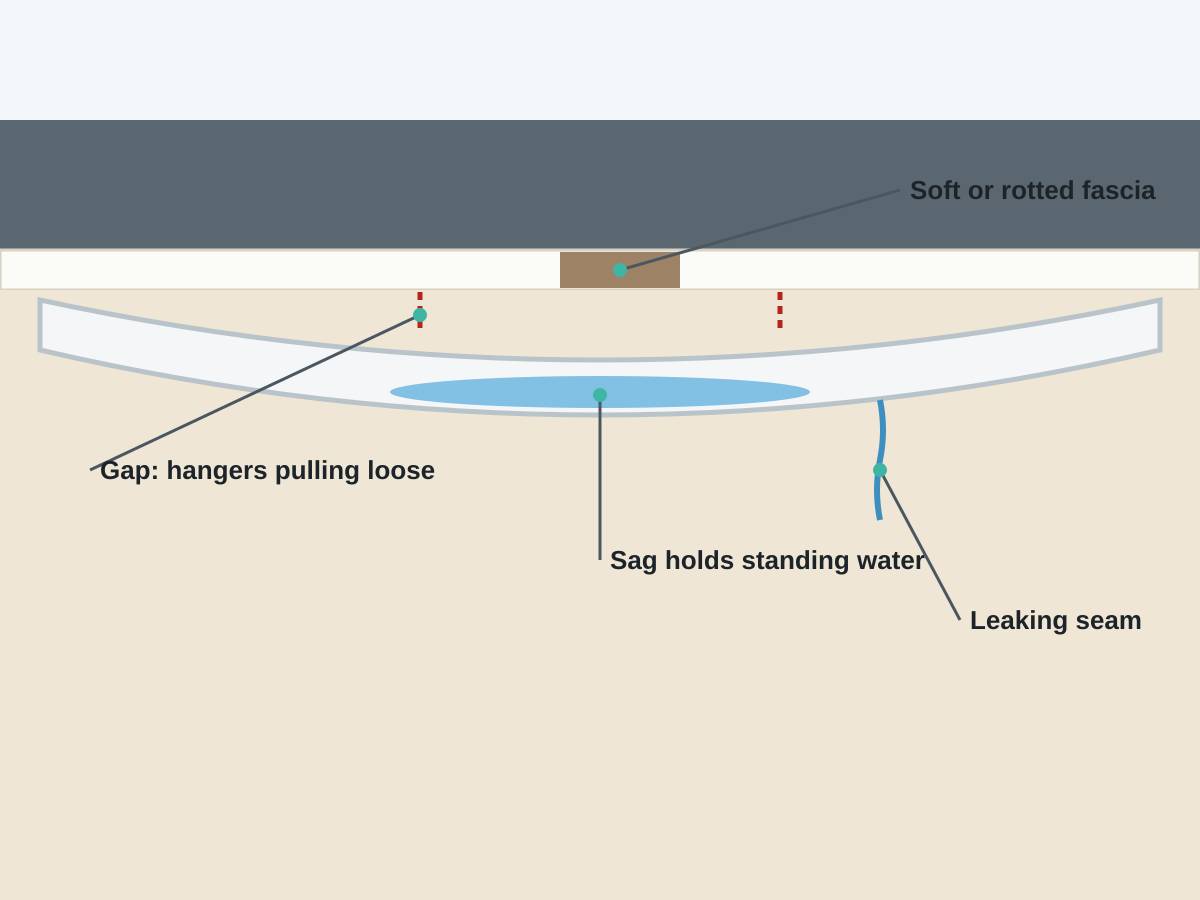
How a gutter should be attached
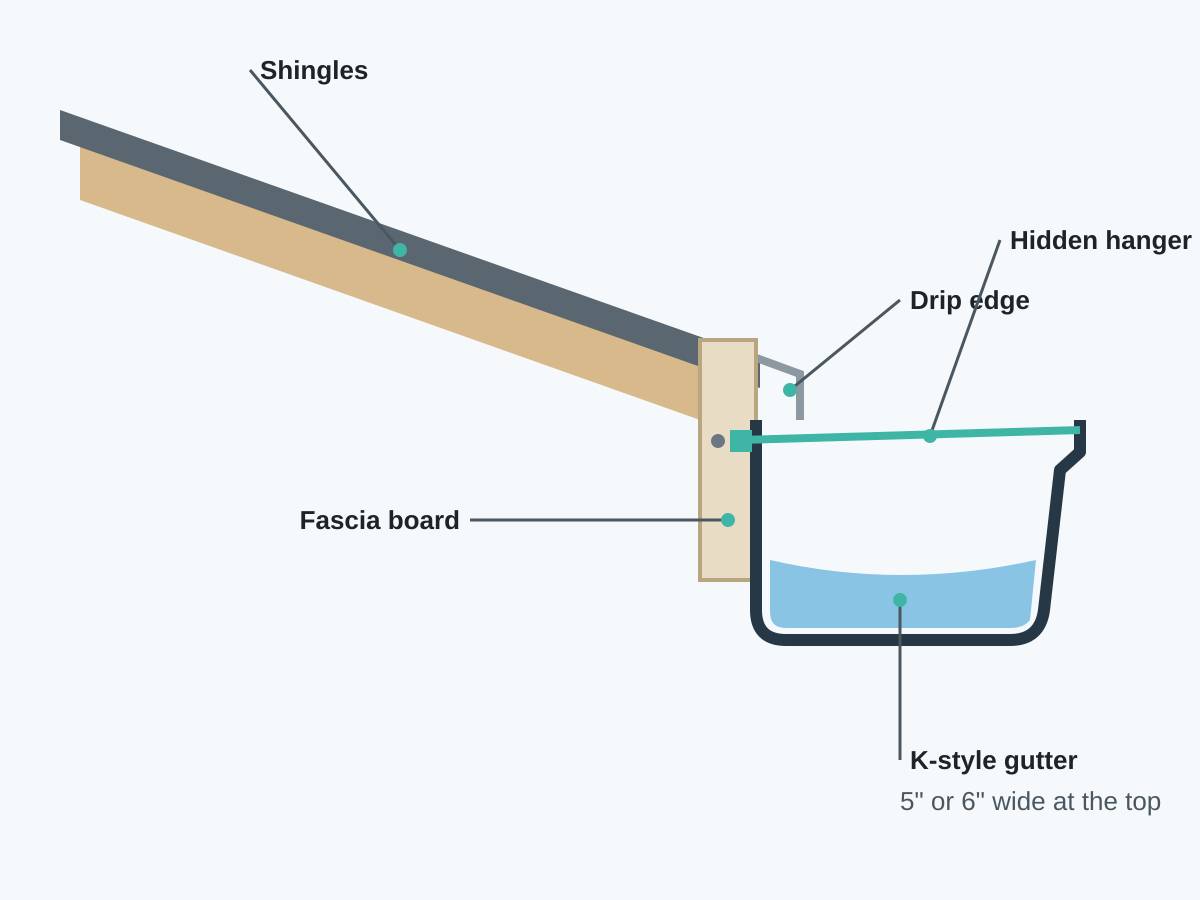
The gutter hangs from the fascia, the board across the ends of the roof rafters. Hangers along the run hold it tight to that board and just below the roof edge, and a metal drip edge guides water off the shingles into the trough. The gutter slopes slightly toward its downspouts. When any link in that chain fails, whether the fastener, the wood, the slope or the load, the gutter starts to pull away.
Six reasons gutters pull away
1. Old spikes backing out
For decades, gutters were hung with long spikes driven through a sleeve (a ferrule) into the fascia. Every summer heat wave, winter cold snap and load of wet leaves pushes them out a little, and the hole slowly widens. It is the most common cause on Hoover homes built before the 2000s, from Bluff Park ranches to Riverchase two-stories.
What to look for: Spike heads sticking out past the front lip of the gutter, or daylight between the back of the gutter and the board.
2. Soft or rotted fascia
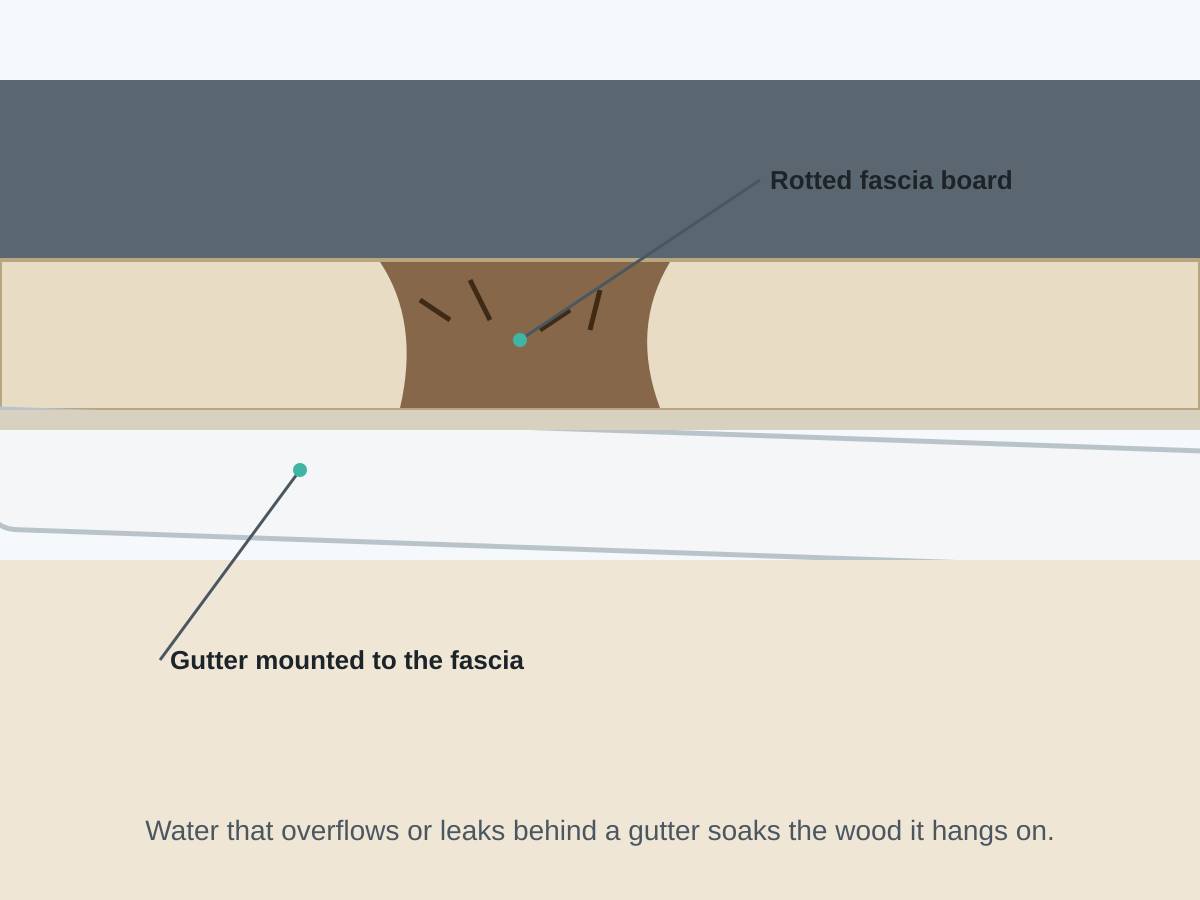
A hanger is only as strong as the wood behind it. Years of overflow, or rain running behind the gutter because there is no drip edge, soften the fascia until screws have nothing to grip. Alabama humidity and heavy shade keep the wood damp, so rot moves faster under trees.
What to look for: Peeling paint, dark streaks or soft spots on the fascia, and sometimes sagging soffit below it.
3. Heavy, wet debris
A gutter packed with wet oak leaves, pine straw and pollen paste, with water sitting on top, is far heavier than an empty one. Under a thick canopy that weight builds between cleanings and pries on every hanger. The rare Birmingham ice storm adds even more load to a full gutter.
What to look for: Gutters that also overflow in normal rain, have plants growing in them, or look full from the yard.
Staying ahead of the debris is the cheapest prevention. The Hoover gutter calendar shows when each kind of tree fills the gutters.
4. Too few hangers, or hangers in the wrong place
Hangers spaced too far apart, screws that missed the rafter tails, or cheap plastic clips leave long unsupported spans. The gutter bows between supports, water collects in the bow, and the problem grows.
What to look for: A gentle belly between two hangers, or hangers you can count and find far apart.
5. Wrong slope
Gutters need a slight fall toward each downspout. A run hung dead level or sloped the wrong way holds water. That constant weight and moisture loosens the hangers and rots the wood behind the low spot.
What to look for: Standing water in a clean gutter a day after rain, or overflow at the end farthest from the downspout.
6. Storm damage and impacts
Falling limbs, high winds and hail in spring storms bend sections and snap hangers. So can a ladder leaned against the gutter, or a sheet of water pouring off a steep upper roof onto a lower one.
What to look for: A dent or kink in one spot, often with a bent hanger, and debris from the storm nearby.
After a storm, check from the ground before anyone climbs. Our after-the-storm checklist covers what to look for and photograph.
Why it is worth fixing soon
A small gap changes where the water goes:
- Water runs behind the gutter, soaking the fascia and soffit and speeding up rot.
- Roof water lands on the foundation. On Hoover's hillside lots with red clay soil, that means wet basements and crawl spaces, washed-out beds and erosion.
- Siding, brick and trim stain where water sheets down the wall.
- It gets worse on its own. Every failed hanger puts more load on the next one.
- A heavy section can fall, especially from a tall basement-side eave.
Stay safe: don't climb up to push a loose gutter back or lean a ladder against it; a failing gutter cannot hold a ladder. Inspect from the yard, keep everyone out from under a hanging section, and never climb onto a steep or two-story roof.
What a professional should check
- Fasteners: spikes, hidden hangers or clips, how many have failed and how far apart they are.
- Fascia: probing for soft wood behind and between hangers, and checking the soffit below.
- Drip edge: whether it exists and whether the gutter sits correctly under it.
- Slope: whether each run drains toward its downspout.
- The gutter itself: seams, corners, dents, and whether it is big enough for the roof above.
- Downspouts and drains: a plugged outlet makes the gutter hold water and weight.
Repair or replace?
| What is found | Usual approach |
|---|---|
| Gutter is sound; a few spikes or hangers failed | Re-hang with hidden hangers into solid wood and reset the slope |
| One area of soft fascia behind a loose section | Replace that piece of fascia, then re-hang the gutter |
| Leaks at many seams, repeated patching, dents along several runs | Replacement is often better value than more repairs |
| Gutters overflow even when clean | Upsize to 6-inch seamless gutters and add downspouts |
| Rotten fascia on most sides of the house | Replace the fascia and hang new gutters at the same time |
Most pulling-away problems on otherwise healthy gutters are a gutter repair: hidden hangers into solid wood, a corrected slope and resealed corners. If the board behind is rotten, fascia and soffit repair comes first, or the new hangers will fail the same way.
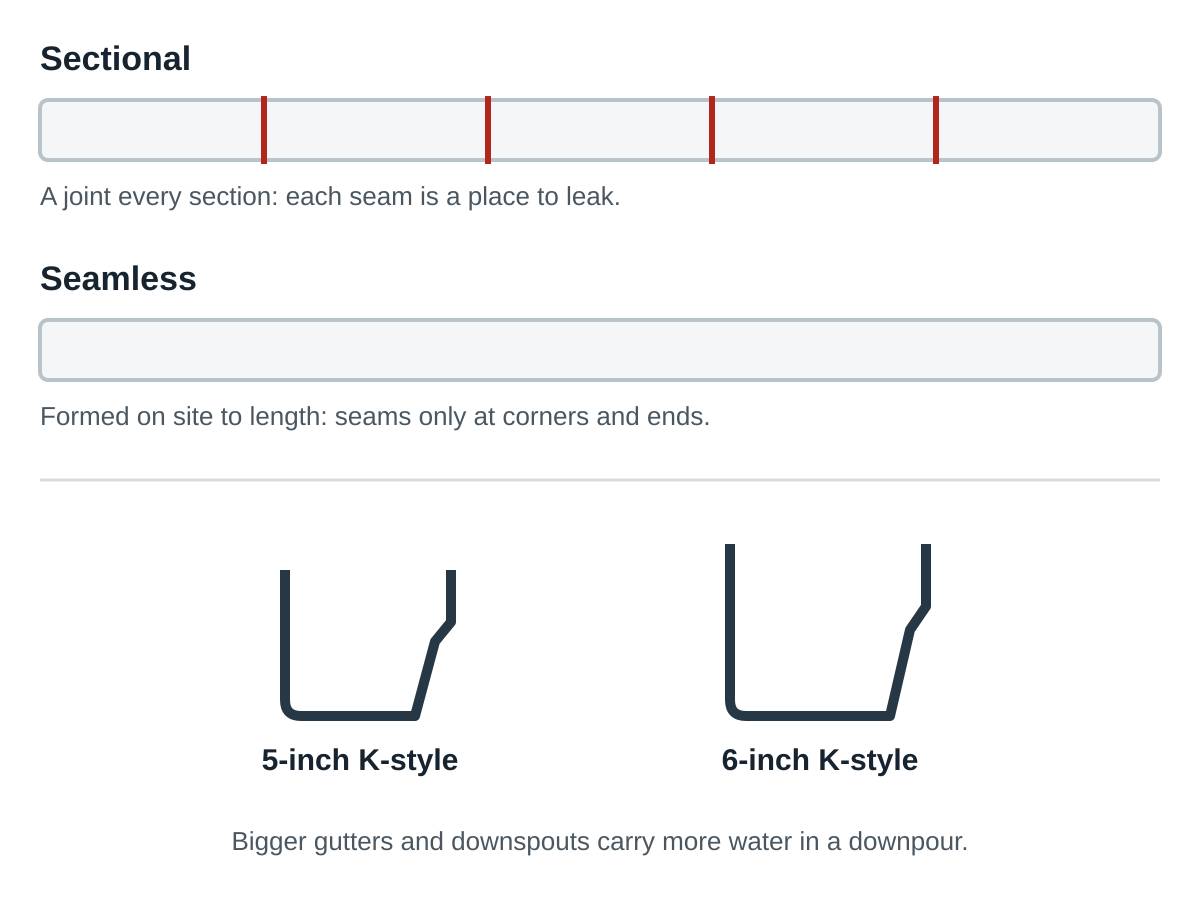
If the gutters are old, leaking at many seams, dented or too small for the roof, replacement may be the better value. Seamless gutters are formed to length on site and hung with modern hangers, which removes most of the weak points. Older homes with copper or half-round gutters, like some in Bluff Park, may call for a repair that keeps the original style.
Preventing it next time
- Keep the gutters and downspouts clean so the weight never builds up. See gutter cleaning in Hoover and downspout cleaning.
- Ask for hidden hangers at close spacing whenever gutters are re-hung.
- Make sure there is a drip edge so water cannot run behind the gutter.
- Only add guards to gutters that are firmly attached; see the gutter guards page and are gutter guards worth it?
- Never lean a ladder against the gutter itself.
Seeing a gap or a sag? Call (205) 973‑4758 or request a free estimate. A photo from the ground helps. We'll connect you with an experienced, qualified local professional in Hoover.